
 English (United Kingdom)
  Arabic (اللغة العربية)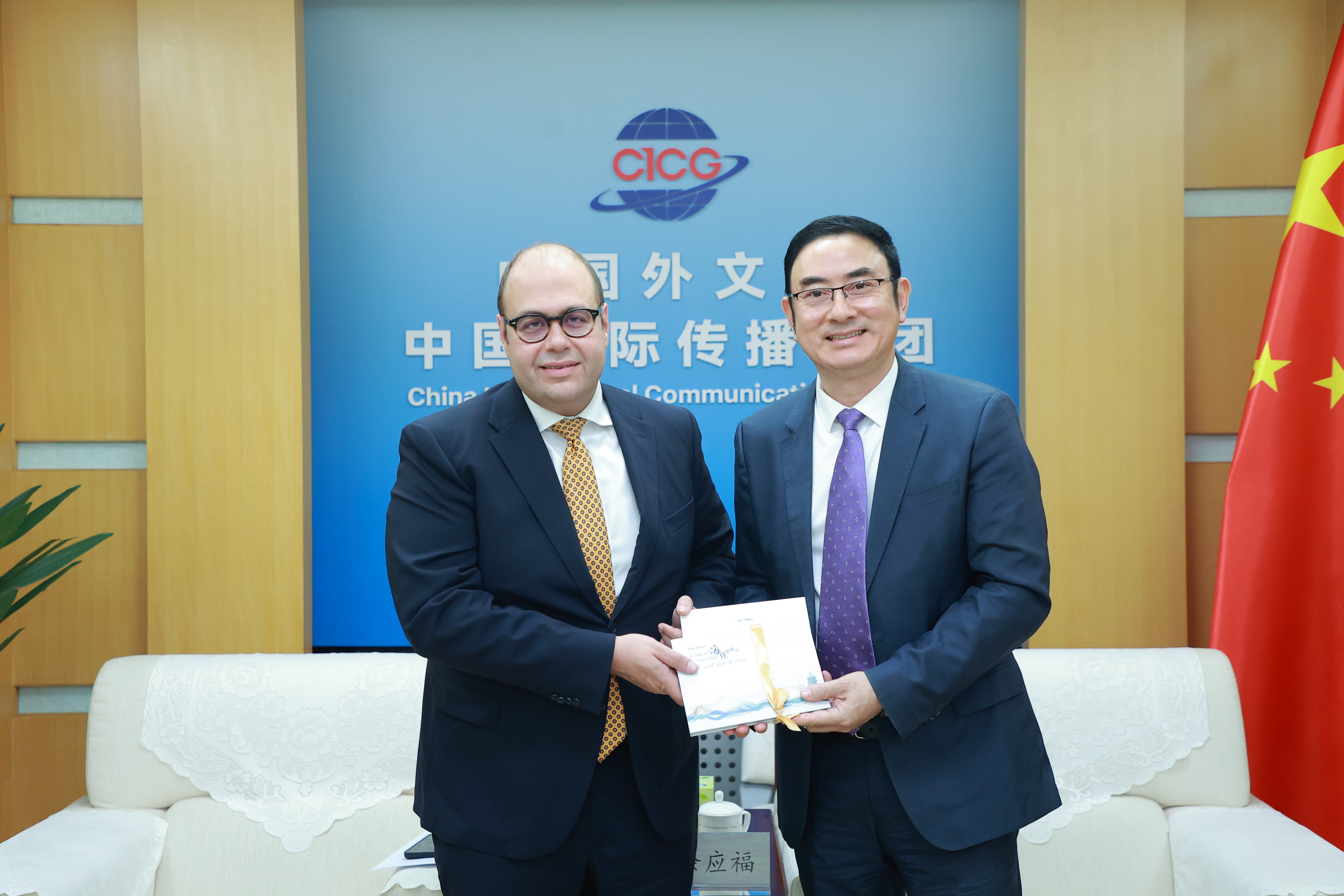
A Tale of Two Cities, a China-Egypt co-produced documentary, was officially launched in Beijing on August 19, 2026, at the China International Communications Group. The event was jointly hosted by the Fujian Provincial Bureau of Radio and Television and Fujian Media Group, and organized by the Satellite TV Center of Fujian Media Group.
The event was attended by officials from the China International Publishing Center, the Embassy of the Arab Republic of Egypt in China, the Fujian Provincial Bureau of Radio and Television, and Fujian Media Group, as well as industry experts, members of the production team, and representatives from Xinhua News Agency, People’s Daily Overseas Edition, Guangming Daily, China News Service, China Daily, Global Times and other media outlets. Together, they witnessed the upcoming simultaneous broadcast of the documentary on mainstream media in China and Egypt.
Building Consensus and Opening a New Chapter in China-Egypt Film and Television Cooperation
2026 marks the 70th anniversary of the establishment of diplomatic relations between China and Egypt, as well as a pivotal year for deepening cooperation between the two countries in industry and culture.Produced by Fujian Media Group, the four-episode documentary A Tale of Two Cities is the first contemporary-themed documentary jointly produced by official television organizations from China and Egypt focusing on contemporary people-to-people exchanges and cooperation between the two countries.Taking Quanzhou in China and Alexandria in Egypt, two ancient port cities with a millennium-long connection to the Maritime Silk Road, as its geographical coordinates, the documentary records stories of exchanges between Chinese and Egyptian people in areas including trade, culture and education, while showcasing vivid examples of mutual learning between Chinese and Egyptian civilizations under the Belt and Road Initiative. In 2024, Fujian Media Group and Egypt’s National Media Authority formed a joint production team. After two years of filming and production, the documentary was completed as a four-episode series, with each episode running 15 minutes.In June 2026, the documentary was selected for the Third “New Era, New Images” China-Foreign Joint Production Initiative. On August 20, it was presented as an outstanding achievement in China-Africa radio and television cooperation at the 7th China-Africa Media Cooperation Forum.
Zhang Jinting, Director of the China International Publishing Center, said in his address that 2026 marks both the beginning of the 15th Five-Year Plan and the 70th anniversary of the establishment of diplomatic relations between China and Egypt. The convergence of these two historic milestones gives the launch event particular commemorative significance and communication value.According to Zhang, A Tale of Two Cities advances the goal of telling the world stories of Chinese modernization from three dimensions.First, by grounding its narrative in the everyday lives of ordinary people, the documentary conveys the openness, inclusiveness and human warmth of Chinese modernization.Second, by drawing on millennia of civilization as the foundation of its narrative, it explores the cultural essence of Chinese modernization, characterized by inclusiveness and openness to diverse civilizations.Third, through international co-production as an innovative approach, it broadens the perspectives through which Chinese modernization can be communicated to international audiences.
Wang Zhong, Director of the Fujian Provincial Bureau of Radio and Television, noted in his address that Fujian is a core area of the 21st Century Maritime Silk Road.In recent years, the Fujian Provincial Bureau of Radio and Television has consistently made strengthening international communication capacity and telling Fujian’s Maritime Silk Road stories key priorities. It has continued to promote China-foreign joint productions, people-centered narratives that foster emotional resonance, and integrated overseas media outreach, with the aim of building credible, endearing and respectable of Fujian. Closely aligned with the international communication agenda of the Publicity Department of the CPC Central Committee and the National Radio and Television Administration, and deeply integrated into Fujian’s overall international communication strategy, A Tale of Two Cities builds a bridge for dialogue between civilizations across mountains and seas through film and represents a successful practice distinguished by both strong results and distinctive features.
People as the Medium: Exploring the Key to Emotional Resonance in Cross-Cultural Communication
As suggested by its title, A Tale of Two Cities is not merely about two cities echoing one another across the sea. It is also about two civilizations moving Toward each other across the river of time.
The documentary turns its lens Toward ordinary people involved in China-Egypt exchanges—including entrepreneurs and businesspeople, tourism professionals, cross-border families, inheritors of incense-making traditions, and archaeologists.As “people-to-people ambassadors,” they cross cultural barriers through everyday interactions, becoming authentic examples of cross-cultural exchange.
The event also featured a seminar titled “People as the Medium: The Value and Pathways of People-Centered Narratives in International Communication,” moderated by Peng Kan, Lecturer at the School of Arts and Communication at Beijing Normal University and Editor-in-Chief of Film and Television Industry Observer.
Hong Lei, Vice Chairman of Fujian Media Group, spoke about the original vision behind the project.
He noted that, as a core region of the Maritime Silk Road, Fujian has always maintained a strong sense of responsibility and awareness in international communication and exchanges. In recent years, Fujian Media Group has focused its documentary production on three major themes: the Taiwan Strait, the Maritime Silk Road and the ocean.Egypt, as an important country in Africa and the Middle East and one of the world’s ancient civilizations, shares a special and profound relationship with China, making it an ideal partner for international documentary co-productions.
In 2020, the Cultural Counselor of the Embassy of Egypt in China was first invited to conduct field visits to Fuzhou and Quanzhou. Building on communication and mutual trust, the two sides gradually brought A Tale of Two Cities to fruition.Hong expressed the hope that the documentary would connect contemporary people-to-people exchanges between China and Egypt with memories of the ancient Maritime Silk Road, using individual stories as entry points to reveal broader themes and convey the genuine and tangible emotional bonds between the peoples of the two countries.
Yin Hong, Professor at the School of Journalism and Communication at Tsinghua University and Vice Chairman of the China Film Association, summarized three major features of the documentary.
First, set against the backdrop of China-Egypt relations, the documentary is rooted in the everyday lives of ordinary people and covers a wide range of fields, including economy, trade, culture, history and education.Second, it adheres to a people-centered creative philosophy. The characters become part of one another’s lives, conveying the emotions and mutual respect between the peoples of China and Egypt in subtle and natural ways.Third, the documentary possesses a strong sense of historical depth. It extends the perspective of civilizational exchange into a profound historical dimension, reaffirming the longstanding friendship between China and Egypt as two ancient civilizations.
Li Fang, Deputy Editor-in-Chief of People’s Daily Overseas Edition, analyzed four transformations and four forms of awareness reflected in the documentary.
The four transformations are the transformation from academic language to public discourse, from Chinese expression to a global context, from textual reading to experiential perception, and from traditional forms of expression to modern communication.The four forms of awareness are an awareness of the ocean, history, audiences and communication.Built around maritime culture, with the history of the Maritime Silk Road as its narrative thread and real stories and everyday details as its vehicles, the documentary is emotionally engaging and demonstrates significant potential for international communication.
He Suliu, Deputy Dean of the Faculty of Journalism and Communication at Communication University of China and Director of the China Documentary Research Center, summarized the documentary’s creative characteristics.
First, its narrative levels are clear and its structure carefully designed, progressing from the histories of the two ancient civilizations to contemporary China-Africa and China-Egypt relations, and ultimately to the connections between the two cities.Second, the selection of stories from the two cities is precise and vividly presented. For example, the scenes of a cross-border Chinese-Egyptian family living happily together offer one of the most vivid illustrations of civilizational exchange.Third, the documentary conveys a broad vision within a compact format. Although the series consists of only four 15-minute episodes, it encompasses a wide range of subjects, including trade, culture, education and archaeology, achieving a broader perspective through intimate stories.
Zhang Yanli, Executive Deputy Director of the Broadcasting and Television New Perspectives Center and Secretary-General of the Documentary Academic Committee of the China Television Artists Association, noted that A Tale of Two Cities possesses three key elements that make a documentary compelling to watch.
First, it creates contrast and juxtaposition. The ancient Port of Citong in Quanzhou, once the largest port in the East during the Song and Yuan dynasties, and Alexandria, a port city with thousands of years of history, face each other across time and space, creating a striking historical and geographical contrast. Second, its narrative and editing logic are clear, creating a distinctive audiovisual rhythm. Third, people remain at the heart of the documentary. The production team conducted extensive on-location filming in both countries, recording the real lives of ordinary people and reflecting the larger historical era through individual stories, giving the documentary lasting value as a record of its time.
(Zhang Yanli, Executive Deputy Director of the Broadcasting and Television New Perspectives Center and Secretary-General of the Documentary Academic Committee of the China Television Artists Association)
The launch event concluded successfully with a group photo and media interviews.According to the organizers, A Tale of Two Cities will soon be officially broadcast on mainstream media in China and Egypt, meeting audiences both at home and abroad.