
 English (United Kingdom)
  Arabic (اللغة العربية)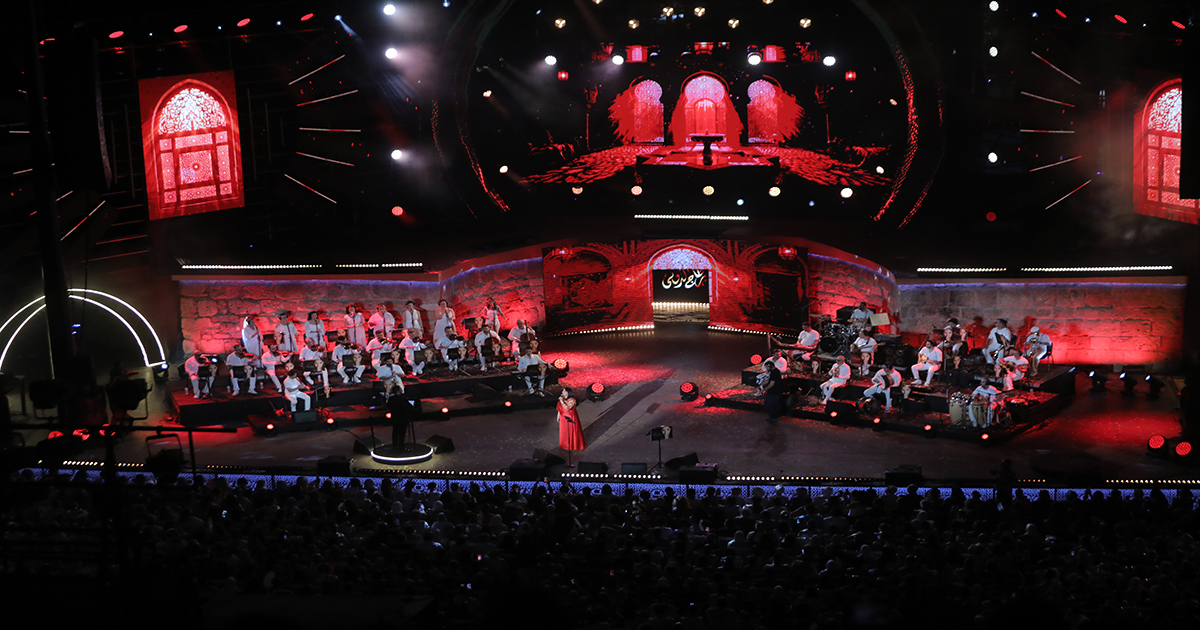
The Lady of the Theatre, passionately mad about the stage, the Diva Amina Fakhet, met her audience on an exceptional night, August 17, 2026, as part of the 60th edition of the Carthage International Festival. The concert was musically orchestrated by the National Orchestra led by Maestro Youssef Belhani, with the participation of musicians from Algeria. It was a rendezvous with an artist unlike any other—an artist who made the stage her own kingdom and the audience her subjects, enchanting them with her voice, movement, and commanding presence.
The concert opened with a dance tableau, after which the National Orchestra was given the stage to write the most beautiful notes in welcome of the Queen of the Night, "the Diva," on the ancient Carthage stage, crowned with love and surrounded by dancers. The scene was majestic, as if the entire theatre awaited the moment of her entrance—the moment when the stage would transform into a magical space that speaks only Amina Fakhet's language.
The Lady of Tarab, with her powerful voice and exceptional presence, is a Tunisian artist beloved by her audience, representing a unique phenomenon. Amina Fakhet, the artist behind the masterpiece "Sultan Hubek," cast her spell once again over her followers on the Carthage stage. She is not merely an artist but a complete artistic phenomenon. On stage, she creates a dazzling spectacle—her way of singing, her movements, her interaction with every note and melody, and her audience's reactions, all weave together to make her a master of spectacle. Watching Amina feels like witnessing a fully integrated scenography, an artistic monodrama that she masterfully writes both on stage and through her voice.
After an eight-year absence, Amina returned to Carthage carrying a longing to meet her audience, who resonate with every song or even every "sigh" she emits when she fully connects with the melody. Carthage has a special flavour for her: "Love, I want the energy of love, I love you so much" – this is what she said after every rhythm, as if declaring that this night was not just a concert, but a spiritual encounter between her and those who love her.
Every time she sang, she became ecstatic, as if transported to a metaphorical realm beyond time—a state of unity with the melodies and lyrics, resembling the harmony of Sufis with their spiritual worlds. Just as a Sufi's body gradually elevates during whirling, so too does Amina lift her audience, carrying them far away to timeless metaphors to enjoy the beauty of art. She is not just a singer performing songs; she is a storyteller recounting tales through body movement and vocal tone, taking the listener on a journey that begins with their pain and ends with their joy.
The concert was a musical journey, featuring her most famous songs from her repertoire: "Sultan Hubek," "Al Jabeen Asaba," "La Mara," "Aho Jani" by Mohamed El Assoued, "Tashbah Al Sukkar" and "Inta Tou'id Wa Tukhlef" by Ahmed El Majri, "Ya Reis El Bahr" by Thamer Alwani, and she also sang for Mohamed El Rouafi from Libya. Each song was a stop on a journey through her artistic history, where she rediscovered herself with every note. Amina has a unique ability to make the audience love a song and interact with it even when she sings it for the first time—she took a risk and performed her new production "Mazal Badri," proving her ability to command the stage and capture the audience's attention, as if to say that the new can feel old in their hearts from the very first moment.
From her beginnings, Amina Fakhet chose to carve her own path, blending tarab with spectacle, singing with performance art, and succeeding in transforming every appearance on stage into a moment of collective celebration, fuelled by emotion, improvisation, and spontaneity. She is a unique phenomenon, excelling in creating dance scenography, penetrating the visual memory of her audience, and redefining body language so that dance becomes her distinctive constitution in her encounters with her fans. Among the evening's aesthetic highlights was the stage scenography, featuring lively, warm colours with the Diva's image at its centre—as if the image itself was part of the performance, telling the artist's story through her eyes and smile.
She sang for love, wrote for the most beautiful encounters, and wove the most beautiful shawls for joy. From her madness on stage, Amina mastered the carving of creative paths that mirror her unique self. Her encounter with the Carthage audience, who interacted and became ecstatic in her presence, was among the most sincere spontaneous moments. There was no distance between her and her audience—only a state of fusion, where the audience became part of the show, and the stage extended into the stands.
Amina Fakhet moved seamlessly from emotional songs to tarab and performance pieces, harmonised with calm melodies, and danced to the rhythms of folk songs. She is, as everyone sees her, a unique phenomenon with her own worlds on stage, excelling in musical interaction with all styles and colours without losing her artistic identity. In short, like mosaic pieces scattered before the show, she brilliantly assembles them from the moment she steps onto the stage.
The Diva's evening at the Carthage International Festival was defined by noise and madness—a captivating encounter between a unique artist and an audience thirsting for moments of spellbinding joy. The bond between her and Carthage remains a renewed covenant of success, and on this night, Amina Fakhet proved once again that she is not just a voice but a complete state, an integrated theatre, and an unforgettable memory in the hearts of all who witnessed her.