
 English (United Kingdom)
  Arabic (اللغة العربية)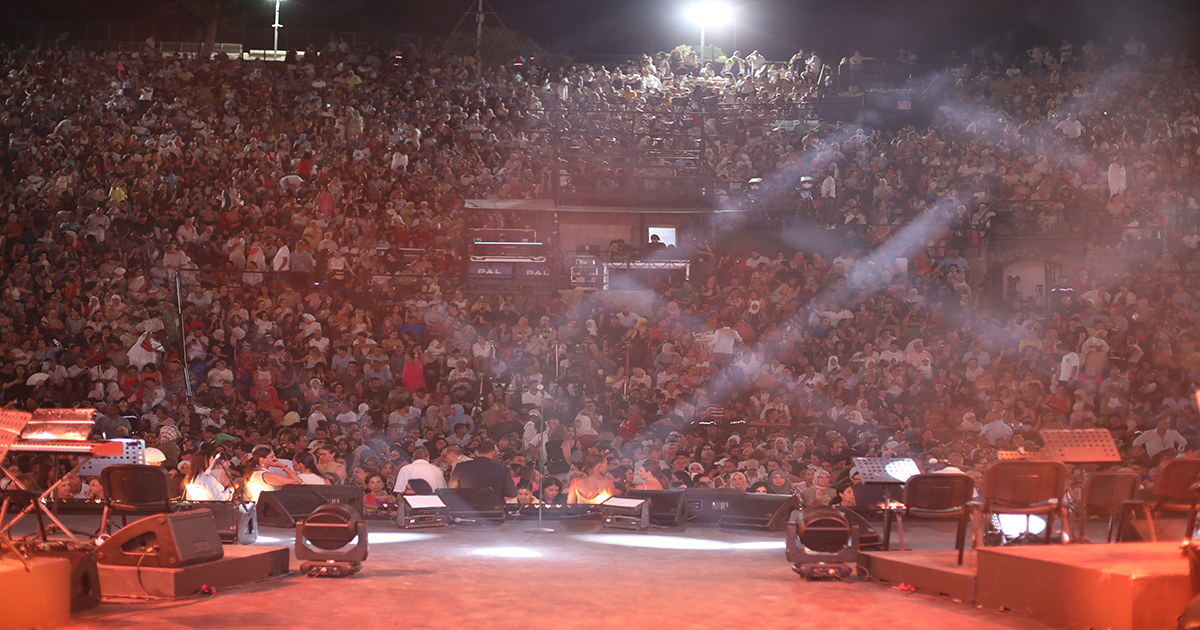
The curtain fell on the 60th edition of the Carthage International Festival, concluding with an exceptional performance on the evening of Wednesday, August 19, 2026, by a unique artist, an icon of peace with a powerful voice and a dazzling presence—Majida El Roumi. The star who began her career in the 1970s and succeeded in building a distinctive artistic experience, blending singing with acting, appeared on the Carthage stage carrying peace and love, sharing with her audience the most beautiful moments of gratitude, affection, and joy.
"I do not consider this a concert; it is a wedding, and at a wedding we all sing—so let us sing for love and peace." This is how Majida El Roumi opened her encounter with the audience, adding: "I wish goodness and prosperity for Tunisia and its people." Her words were an announcement of the nature of the evening—not merely a vocal performance but a collective celebration of life, a spiritual feast uniting the artist and her audience in the embrace of beauty and humanity.
Few artists can bring their audience to a state of ecstasy and immersion in art, and Majida El Roumi is one of those unique creators whose voice, once heard, makes your ear refuse to listen to anything else, as you try to hold on to the echo of a sound so full of feeling that it gives life meaning. She is not merely a singer but an existential state reflected through music, where voice becomes a mirror of the soul and a revelation of the self.
Majida's presence on stage is breathtaking. Her encounter with the Tunisian audience was astonishing—an audience whose love she affirms with every fibre of her being. She appeared carrying joy, her passion being creativity and sharing a space of love on the Carthage stage, possessed by life despite all pain. From Tunisia, she sent a greeting to her homeland Lebanon and its people's struggles—Lebanon of resilience and dignity, despite the hellish machinery of war, a people who invented joy and redefined it many times to express their steadfastness... and to them she sang.
Art is commitment, and Majida El Roumi has been committed to her homeland's causes since her early days. An artist who chose her voice as a weapon to defend Lebanon and all the oppressed. With her voice, she writes the strongest cries against all forms of aggression. She is Lebanon's daughter and beloved, its voice and echo. Since her debut, she has loved her country and triumphed for every inch of its soil, singing "Am Behlamak Ya Lebnan" (I Dream of You, Lebanon) in 1975, after the outbreak of war, with lyrics by Said Akl and music by Elias Rahbani—a song that became an anthem of resilience, carried by Majida to every stage she graced.
Her name was written in love in the sky of art—a voice that sang for freedom and peace, as well as the most powerful poems. The child whose father initially opposed her entry into the arts has become the lady of every Arab and international stage. From "Ya Tayour," her first song in Studio 74, a tribute to Asmahan, to "Oul Ya Albi," her latest release, Majida remains a voice illuminating dark paths, an artistic language that breaks all boundaries and transcends geography.
On a summer night that will be etched in the memory of everyone present, Majida led the journey of art and music, giving everyone a dose of happiness at the close of Carthage's 60th edition. She sang for her followers: "Kalimat," "Aynak Layali Sayfiya," "Am Yis'alouni," "La Tas'al," "I'tazalt Al Gharam," "Kun Sadiqi," "Matrahak Bi Qalbi," and others—writing a renewed date with success, echoing the one she began in 1980. Each song was a station in the journey of her artistic life, rediscovering herself along with her audience, who repeated the lyrics as if hearing them for the first time.
A voice carrying longing, delicacy, and artistic sublimity, with a style that bets on dignity and powerful performance. Majida left music and words to lead the artistic moment, while her calm presence and unique aura gave her the ability to create a state of ecstasy, harmony, and unparalleled connection with the Tunisian audience, who sang with her in classical Arabic. No translation or mediation was needed—words reached directly to hearts, and melodies flowed through veins like water of life.
That exceptional voice gives musicians the opportunity to create and write the most beautiful notes of nostalgia. Majida El Roumi is a name preserved in Arab memory, a landmark in music, an artist who excelled in singing the poems of the greatest poets, from Nizar Qabbani to Mahmoud Darwish, with "Kalimat" becoming an anthem of love, adorned by the power of her voice. She can transform poetry into melody, melody into feeling, and feeling into a state of spiritual ecstasy unrivalled by any other pleasure.
Majida has a special relationship with Tunisia. From the Carthage stage, she rose to fame, her actual launch taking place in 1980. Every time she returns to this country, she expresses her gratitude and respect for the Tunisian audience. She sang from Tunisia's heritage: "Lamouni," "Yami El Aouina," "Khali Badalni," and "Ya Khalila"—a tribute from an artist repaying the favour to a country that opened the doors of glory for her. In 2010, she received the First Class of the National Order of Cultural Merit, was received by President Béji Caïd Essebsi in 2017 at Carthage Palace, and in 2015 made a solidarity visit after the terrorist attack at the Bardo Museum. The roots of this relationship extend over 40 years, full of love and success. "Tunisia embraced me, and I will never forget its favour"—and she sang to all Tunisians in the Tunisian dialect.
Thus, Majida El Roumi renewed her encounter with her audience, bringing back nostalgia for the beautiful song in both word and melody, her eyes welling with tears at times before the sincerity of the love her audience showered upon her. From Tunisia to Lebanon, she wove the most beautiful bridges of lyrical connection, reaching ecstasy for two hours, forgetting time and space, fully merging with the music. Her audience listened when she spoke, because silence in the sanctuary of beauty is itself beautiful.
The curtain fell on the 60th edition of the Carthage International Festival with a dazzling encounter befitting this prestigious event, with an artist from the beautiful era who accumulated successes and wrote her name in golden letters. Thus ended this edition after a series of artistically and popularly successful performances, leaving memories in the hearts of the audience that time cannot erase, and reaffirming that Carthage, with its ancient stones and setting sun, will remain an annual meeting point for beauty, creativity, and peace.