
 English (United Kingdom)
  Arabic (اللغة العربية)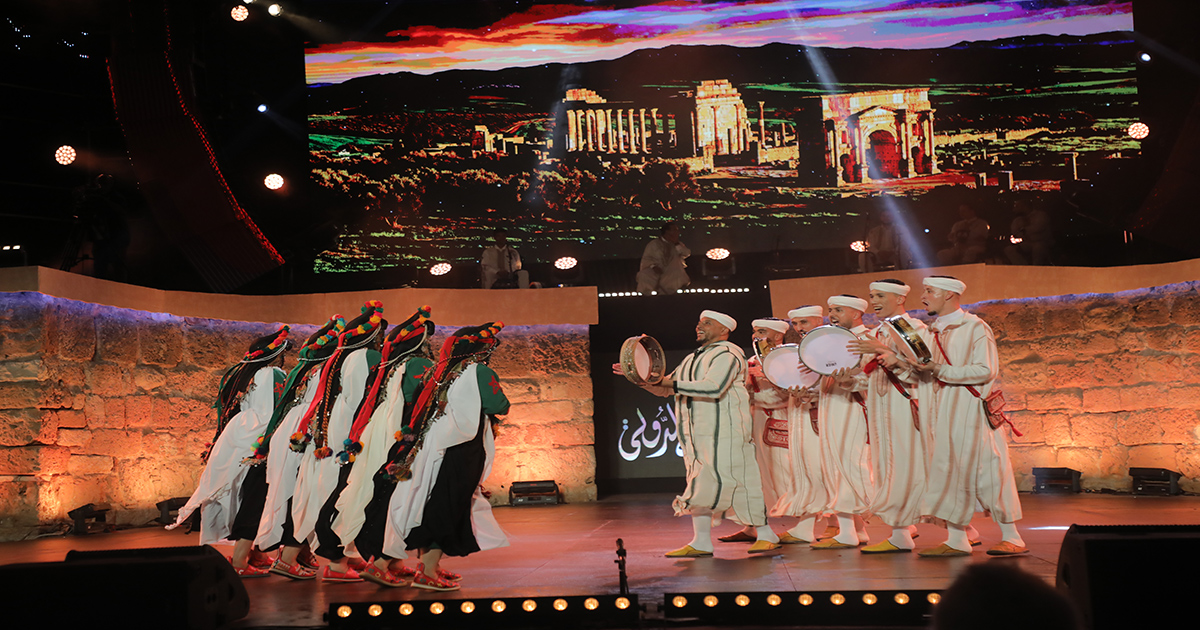
If dance is a language and a space for expression, it is also the voice of the body in all its states, stories, and worlds. On the stage of the Carthage Theatre, the encounter took place on the evening of August 11, 2026, with ten troupes from different countries, gathered for a folklore evening titled "Dances of the World," making dance a means to travel to different cultures and diverse geographies, in the presence of the Minister of Cultural Affairs, Ms. Amina Srarfi, and a number of ambassadors and diplomatic representatives.
On the Carthage stage, Europe's memory, Asia's tales, and North Africa's stories were written through dances that carried the audience to different worlds and promised an encounter with magic. The costumes were embroidered with colours, and the movements and taps on the wooden floor varied according to each dance and its story, each movement or step carrying a different expression, but all shared the meaning of wonder. The evening was like a living map of the world, where every dance step was a stop on a visual and spiritual journey across continents.
The evening opened with the Beijing Opera troupe, with its martial dances and acrobatic movements, evoking the ancient struggles between good and evil. Most dancers wore masks, with makeup covering their faces, the colours indicating the characters' natures (red for courage, black for integrity, and white for evil). This opening was a declaration of an evening blending art, history, and philosophy, where Eastern wisdom manifests in movements dating back thousands of years.
From China to Montenegro, specifically the Academic Cultural and Artistic Ensemble of Montenegro, the dancers' movements were gentle and circular, while their calm rhythms carried the audience on a tour of the breathtaking nature of the Balkan mountains. Then the music changed and became more powerful, as they presented the traditional "Oro" dance, or the Eagle Dance as it is also called, beginning in a circular formation with traditional rhythms and usually ending with a human tower, symbolising strength. The costumes were distinguished by their embrace of heritage, decorated and embroidered in red, white, and black, usually made of silk, with most dances reflecting history, nature, and unity.
Then the Rising Sun troupe from Japan took the stage, meeting the Tunisian audience and presenting the summer "Obon" dances using "Taiko" drums, the central instrument of the performance. The "Nagado-daiko," a long and famous drum widely used in performances and celebrations, added energy to both the troupe and the audience. Japan has many rituals and dances, most famously "Kabuki" and "Nihon Buyo," all with religious and cultural character, reflecting the depth of Japanese culture and its artistic discipline.
Daily life transforms into rhythms: fishermen's movements, women's gatherings, children's smiles, the motion of waves and their music – all these details create from Malta a canvas of dances closely tied to everyday life. This is exactly what the Oghija Folk Arts Troupe presented, taking the Carthage audience on a cultural and historical tour of Mediterranean Malta, performing the most famous national dance "Il-Maltija," characterised by harmonious movements and vibrant rhythms, reflecting stories of love, maritime traditions, and old rural life. Their costumes feature women's colourful embroidered skirts and men's white attire.
From India, the Gujarati Folk Arts Troupe presented spectacular show dances, with folk music possessing a unique charm and magic, their swift movements on stage capturing the audience's attention. From Tunisian Carthage to Indian Gujarat, bodies wrote the most beautiful stories in dances like "Garba" and "Dandiya Raas," both among the oldest and most joyful dances, reflecting the richness and diversity of Indian culture.
From Asia to Africa, the journey continues to the Arab Republic of Egypt, where the American University in Cairo troupe presented the famous Sufi "Mallawiya" dance, with its spinning movements reaching ecstasy, accompanied by chants of "Madad... Madad." They then performed the sailors' dance, evoking the beauty of Alexandria and Port Said. This segment was a tribute to Egypt's rich culture and recognition of its role in shaping Arab cultural identity.
To encompass Africa with joy, the Libyan National Folk Troupe presented a series of tableaux depicting Bedouin life, the stories of rural communities, and inherited values of chivalry, with powerful foot stomps on stage resembling the Bedouins' attachment to their land. Most dances were performed to the music of the mizwid and drum, with dancers in traditional attire including the men's "wizra," while the women's segments featured traditional steps commonly seen at weddings.
From Libya and the mizwid to Algeria and Chaoui rhythms, the audience met the Algerian National Cultural Office troupe, which presented the traditional "Achaouir" dance, highlighting the beauty of Kabyle women and carrying through clothing and jewellery a part of the country's culture. The men's "Adash" shoulder dance was filled with high energy and harmony between music and dancers' movements.
From Algeria to its neighbour Morocco, the appointment was with the Tizwit International Troupe, which celebrated Amazigh music and performed the famous "Nahla" (Bee) dance, one of the troupe's highlights, based on a single movement and regular rhythm among dancers mimicking the life of bees, reflecting human harmony with nature.
As for Tunisia, the host country, the National Folk Arts Troupe presented three tableaux. The first, "Maharem," was a women's dance celebrating the fighting woman, with body language telling stories of women who watered the earth with their blood. To the rhythms of the mrabi, rbukh, and bunwara, the second tableau "Rbukh" was a men's piece with traditional steps. The final tableau was a collective celebration of the culture of life among sailors and farmers, the Tunisian step being a symbol of beauty, cultural extension, and an ancient civilisational heritage.
The Folklores of the World evening, as part of the Carthage International Festival, remains a fixed date for tasting the art and heritage of different countries, an opportunity for discovery and celebration of peoples' cultural wealth. On this night, dance proved to be the most capable language of transcending borders, and that when bodies move in one rhythm, they tell stories that need no translation, affirming that cultural diversity is not a source of division but a window to the beauty of humanity in its most splendid forms.